What Are the Last 3 Surah of Quran?
The last 3 Surah of Quran are:
- Surah Al-Ikhlas — Surah 112
- Surah Al-Falaq — Surah 113
- Surah An-Nas — Surah 114
They are the final three chapters of the Quran and are commonly recited for tawhid, seeking Allah’s protection, morning and evening adhkar, and before sleeping.
Surah Al-Ikhlas teaches the absolute oneness and uniqueness of Allah. Surah Al-Falaq teaches believers to seek Allah’s protection from external forms of harm, while Surah An-Nas teaches seeking protection from the evil of whispers and influences affecting the hearts and minds of people.
Quick Answer: The last 3 Surah of the Quran are Surah Al-Ikhlas (112), Surah Al-Falaq (113), and Surah An-Nas (114). Together, they are commonly known as the three Quls because Surah Al-Ikhlas, Al-Falaq and An-Nas each begin with قُلْ (Qul).
1. Surah Al-Ikhlas — Surah 112
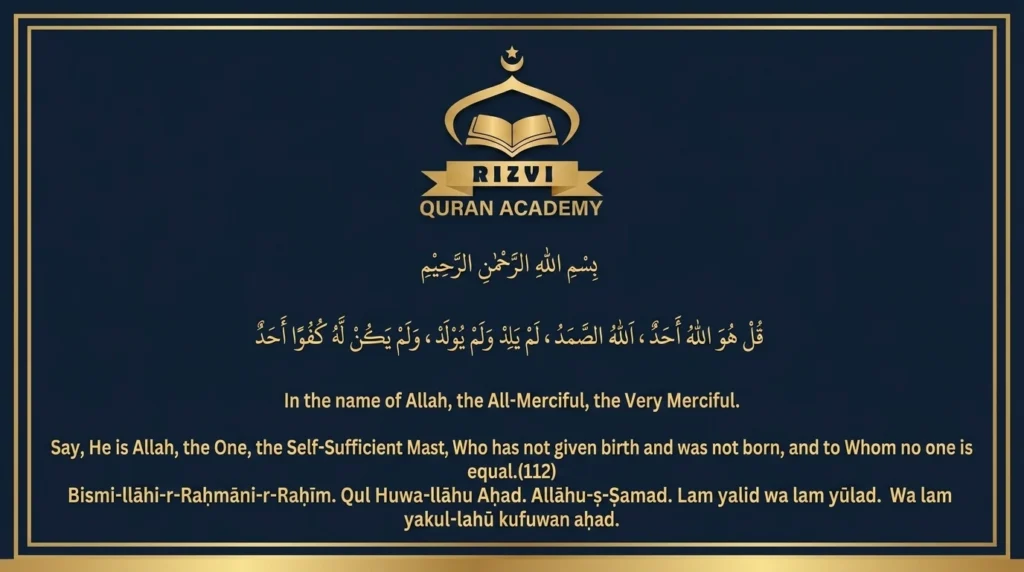
Arabic
بِسْمِ اللّٰهِ الرَّحْمٰنِ الرَّحِيمِ
قُلْ هُوَ اللّٰهُ أَحَدٌ
اللّٰهُ الصَّمَدُ
لَمْ يَلِدْ وَلَمْ يُولَدْ
وَلَمْ يَكُنْ لَّهُ كُفُوًا أَحَدٌ
Roman English Transliteration
Bismillāhir-Raḥmānir-Raḥīm
Qul huwa Allāhu aḥad.
Allāhuṣ-ṣamad.
Lam yalid wa lam yūlad.
Wa lam yakul-lahū kufuwan aḥad.
English Translation
In the name of Allah, the Most Compassionate, the Most Merciful.
Say: He is Allah, the One.
Allah, the Self-Sufficient.
He neither gives birth nor was He born.
And there is none comparable to Him.
Urdu Translation
بسم اللہ الرحمٰن الرحیم
کہہ دیجئے: وہ اللہ ایک ہے۔
اللہ بے نیاز ہے۔
نہ اس نے کسی کو جنا اور نہ وہ جنا گیا۔
اور کوئی اس کے برابر نہیں۔
Meaning of Surah Al-Ikhlas
Surah Al-Ikhlas is a concise declaration of Tawhid, the Islamic belief in the absolute oneness of Allah.
The Surah establishes four fundamental points:
- Allah is One.
- Allah is independent and free of all need.
- Allah has no child and was not born.
- Nothing is comparable or equal to Allah.
For a Muslim, this Surah is therefore not simply a short chapter to memorize. It is a powerful summary of Islamic belief in Allah’s uniqueness.
2. Surah Al-Falaq — Surah 113
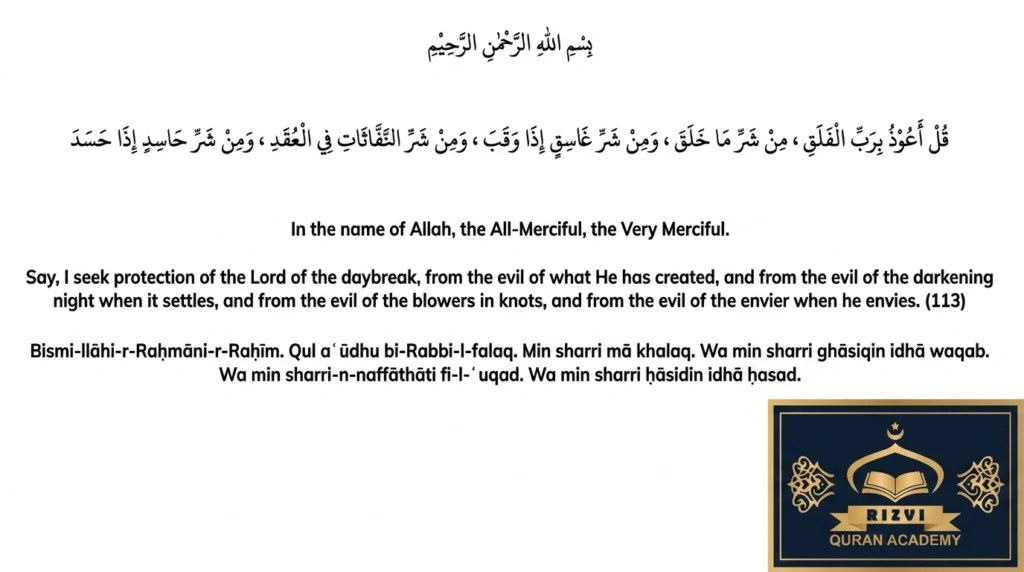
Arabic
بِسْمِ اللّٰهِ الرَّحْمٰنِ الرَّحِيمِ
قُلْ أَعُوذُ بِرَبِّ الْفَلَقِ
مِنْ شَرِّ مَا خَلَقَ
وَمِنْ شَرِّ غَاسِقٍ إِذَا وَقَبَ
وَمِنْ شَرِّ النَّفَّاثَاتِ فِي الْعُقَدِ
وَمِنْ شَرِّ حَاسِدٍ إِذَا حَسَدَ
Roman English Transliteration
Bismillāhir-Raḥmānir-Raḥīm
Qul aʿūdhu bi-Rabbil-falaq.
Min sharri mā khalaq.
Wa min sharri ghāsiqin idhā waqab.
Wa min sharrin-naffāthāti fil-ʿuqad.
Wa min sharri ḥāsidin idhā ḥasad.
English Translation
In the name of Allah, the Most Compassionate, the Most Merciful.
Say: I seek refuge in the Lord of the daybreak, from the evil of what He has created, from the evil of darkness when it settles, from the evil of those who blow on knots, and from the evil of an envier when he envies.
Urdu Translation
بسم اللہ الرحمٰن الرحیم
کہہ دیجئے: میں صبح کے رب کی پناہ مانگتا ہوں، ہر اس چیز کے شر سے جو اس نے پیدا کی، اور اندھیری رات کے شر سے جب وہ چھا جائے، اور گرہوں میں پھونکنے والیوں کے شر سے، اور حسد کرنے والے کے شر سے جب وہ حسد کرے۔
Meaning of Surah Al-Falaq
Surah Al-Falaq teaches believers to turn to Allah for protection from different forms of external harm.
It mentions:
- Harm associated with created things
- Darkness and its potential dangers
- Evil practices involving knots
- The harm of envy
The central lesson is that a believer should seek protection from Allah rather than placing ultimate reliance on any created power.
3. Surah An-Nas — Surah 114
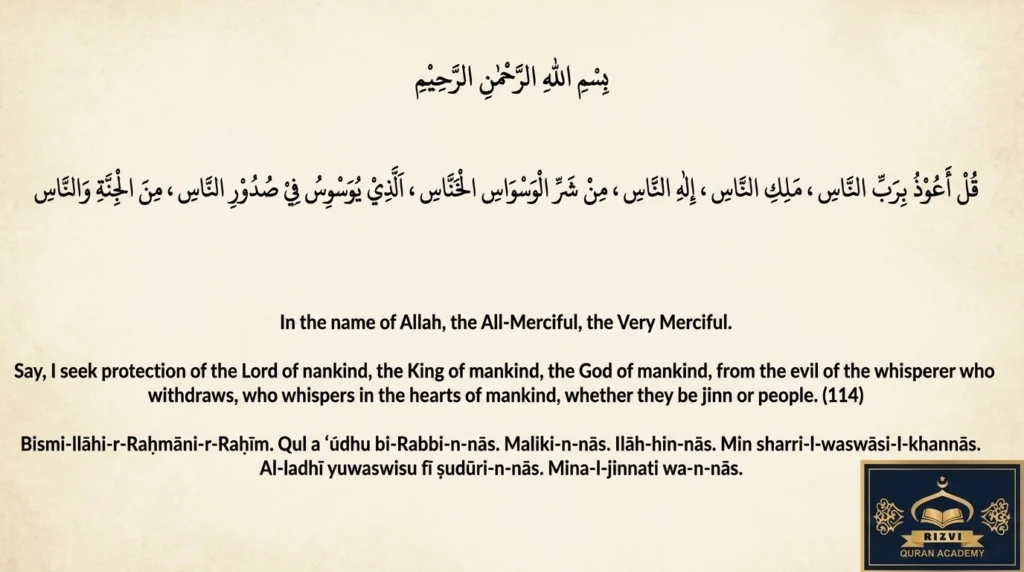
Arabic
بِسْمِ اللّٰهِ الرَّحْمٰنِ الرَّحِيمِ
قُلْ أَعُوذُ بِرَبِّ النَّاسِ
مَلِكِ النَّاسِ
إِلَٰهِ النَّاسِ
مِنْ شَرِّ الْوَسْوَاسِ الْخَنَّاسِ
الَّذِي يُوَسْوِسُ فِي صُدُورِ النَّاسِ
مِنَ الْجِنَّةِ وَالنَّاسِ
Roman English Transliteration
Bismillāhir-Raḥmānir-Raḥīm
Qul aʿūdhu bi-Rabbin-nās.
Malikin-nās.
Ilāhin-nās.
Min sharril-waswāsil-khannās.
Alladhī yuwaswisu fī ṣudūrin-nās.
Minal-jinnati wan-nās.
English Translation
In the name of Allah, the Most Compassionate, the Most Merciful.
Say: I seek refuge in the Lord of mankind, the King of mankind, the God of mankind, from the evil of the whisperer who withdraws, who whispers into the hearts of mankind, from among the jinn and mankind.
Urdu Translation
بسم اللہ الرحمٰن الرحیم
کہہ دیجئے: میں لوگوں کے رب کی پناہ مانگتا ہوں، لوگوں کے بادشاہ کی، لوگوں کے معبود کی، اس وسوسہ ڈالنے والے کے شر سے جو پیچھے ہٹ جاتا ہے، جو لوگوں کے سینوں میں وسوسے ڈالتا ہے، خواہ وہ جنات میں سے ہو یا انسانوں میں سے۔
Meaning of Surah An-Nas
Surah An-Nas focuses particularly on internal and psychological forms of evil, including whispers and harmful influences.
The Surah repeatedly mentions Allah as:
- Rabb of mankind
- King of mankind
- God of mankind
This repetition reinforces that ultimate protection belongs to Allah.
Why Are These Called the Three Quls?
The final three Surah are often called Three Quls (ثلاثة قُل) because each begins with the command:
قُلْ — Qul — “Say”
They are:
| Surah | Number | Main Theme |
|---|---|---|
| Al-Ikhlas | 112 | Tawhid and Allah’s uniqueness |
| Al-Falaq | 113 | Protection from external evil |
| An-Nas | 114 | Protection from whispers and internal evil |
Together, they provide a beautiful combination of belief and seeking protection through Allah.
Last 3 Surah of Quran with Urdu Translation
For Pakistani students and families searching for the last 3 Surah of Quran with Urdu translation, the easiest way to understand their sequence is:
Surah Al-Ikhlas
موضوع: اللہ کی وحدانیت اور بے نیازی
Surah Al-Falaq
موضوع: ظاہری شر اور نقصان سے اللہ کی پناہ
Surah An-Nas
موضوع: وسوسوں اور باطنی شر سے اللہ کی پناہ
Reading the Arabic while understanding the Urdu meaning can help students develop both recitation skills and Quranic understanding.
Last 3 Surahs of Quran in Roman English
For beginners who are still learning Arabic pronunciation, transliteration can provide temporary assistance:
Al-Ikhlas:
Qul huwa Allahu ahad. Allahus-samad. Lam yalid wa lam yulad. Wa lam yakun lahu kufuwan ahad.
Al-Falaq:
Qul a’udhu bi-Rabbil-falaq. Min sharri ma khalaq. Wa min sharri ghasiqin idha waqab. Wa min sharrin-naffathati fil-‘uqad. Wa min sharri hasidin idha hasad.
An-Nas:
Qul a’udhu bi-Rabbin-nas. Malikin-nas. Ilahin-nas. Min sharril-waswasil-khannas. Alladhi yuwaswisu fi sudurin-nas. Minal-jinnati wan-nas.
Important: Transliteration should be treated as a learning aid, not a replacement for learning accurate Arabic pronunciation directly from a qualified Quran teacher.
Last 3 Surah of Quran Benefits
The benefits of these Surah should be understood through authentic Quran and Sunnah evidence, rather than through exaggerated claims circulated online.
1. Strengthening Tawhid
Surah Al-Ikhlas teaches the believer about Allah’s absolute uniqueness and perfection.
2. Seeking Protection from Harm
Surah Al-Falaq teaches believers to seek refuge in Allah from forms of external evil.
3. Seeking Protection from Whispers
Surah An-Nas teaches believers to seek Allah’s protection from harmful whispers originating from jinn and people.
4. Part of Daily Adhkar
The Prophet Muhammad ﷺ taught the recitation of Al-Ikhlas, Al-Falaq and An-Nas as part of protective remembrance.
5. Easy to Memorize
These three Surah contain relatively few verses, making them suitable for children, beginners and new Muslims learning short Surah.
Are the Last 3 Surah of Quran a Wazifa?
A common online search is “last 3 surah of Quran wazifa”.
It is important to distinguish between:
Authentic Sunnah: Reciting these Surah as taught by the Prophet ﷺ for remembrance and seeking Allah’s protection.
Unverified practice: Assigning a specific number of repetitions, a guaranteed worldly result, or a fixed outcome without authentic evidence.
Muslims should avoid claims such as:
“Read this Surah exactly X times and a specific problem will definitely disappear.”
Unless there is reliable evidence from the Quran or authentic Sunnah, such promises should not be presented as established Islamic teachings.
The correct approach is to recite the Quran with ikhlas, understanding, dua, tawakkul and obedience to Allah.
When Should You Read the Last 3 Surah?
The Three Quls are particularly associated with protective daily remembrance.
They can be incorporated into a Muslim’s routine, especially:
- Morning adhkar
- Evening adhkar
- Before sleeping
- During general Quran recitation
- When teaching children daily duas and protection
- When seeking refuge in Allah from harm
The well-known Sunnah practice of reciting Al-Ikhlas, Al-Falaq and An-Nas before sleeping is reported in Sahih al-Bukhari.
A believer should remember that protection comes from Allah, while the Surah are part of the means taught in revelation and Sunnah.
The Last 4 Surah of Quran
People sometimes search for the “last 4 Surah of Quran.”
The last four chapters are:
- Surah Al-Kafirun — 109
- Surah Al-Ikhlas — 112
- Surah Al-Falaq — 113
- Surah An-Nas — 114
However, note that Surah 110 and 111 come between Al-Kafirun and Al-Ikhlas:
- Surah An-Nasr — 110
- Surah Al-Masad — 111
Therefore, the last four chapters numerically are actually:
Surah Al-Ikhlas (112), Surah Al-Falaq (113), Surah An-Nas (114) plus Surah Al-Masad (111).
The Last 10 Surah of Quran
For students memorizing the final portion of the Quran, the final ten chapters numerically are:
- Surah Al-Ma’un — 107
- Surah Al-Kawthar — 108
- Surah Al-Kafirun — 109
- Surah An-Nasr — 110
- Surah Al-Masad — 111
- Surah Al-Ikhlas — 112
- Surah Al-Falaq — 113
- Surah An-Nas — 114
The actual last ten Surah by chapter number begin at Surah Al-Ma’un (107) and continue through Surah An-Nas (114) because the Quran has 114 Surah.
What are the last 3 Surah of Quran?
The last 3 Surah of the Quran are Surah Al-Ikhlas (112), Surah Al-Falaq (113), and Surah An-Nas (114). They are commonly known as the Three Quls. Al-Ikhlas focuses on Allah’s oneness, while Al-Falaq and An-Nas teach believers to seek Allah’s protection from different forms of evil.
Surah Al-Ikhlas
Surah Al-Falaq
Surah An-Nas
How to Memorize the Last 3 Surah
For children and beginners, a simple learning sequence can be effective:
Step 1 — Learn Arabic Letters and Pronunciation
A student should first be comfortable with Arabic letters and basic pronunciation.
Step 2 — Listen to Correct Recitation
Listen to a reliable Quran reciter and follow the Arabic text.
Step 3 — Read One Verse Repeatedly
Rather than attempting the entire Surah at once, learn one verse at a time.
Step 4 — Recite Without Looking
After sufficient repetition, close the Quran and attempt the verse from memory.
Step 5 — Connect the Meaning
Learn the basic meaning in Urdu or English so memorization is connected with understanding.
Step 6 — Daily Revision
Revision is essential. A memorized Surah should continue to be reviewed after initial memorization.
About Rizvi Quran Academy
Rizvi Quran Academy is an online Quran education platform based in Multan, Pakistan, providing Quran learning opportunities for students in Pakistan and internationally.
The academy focuses on Quran reading, Tajweed, memorization, Noorani Qaida and Islamic education through structured one-on-one teaching.
Hafiz Muddasir Rizvi
Hafiz Muddasir Rizvi is the Founder of Rizvi Quran Academy and has 17+ years of experience in Quran teaching, including Quran reading, Tajweed, memorization, Tarjumah and Tafsir.
His stated educational credentials and experience include:
- Certified Hafiz from Tanzeem-ul-Madaris Ahl-e-Sunnat Pakistan
- 1st Position Holder at Jamia Ali Muhammad Islamia
- Award recipient in national examinations conducted by Tanzeem-ul-Madaris Ahle Sunnat Pakistan
- Imam of Ramadan Taraweeh for 5 years
- Sami/listener of Taraweeh for almost 12 years
- Founder of Muddasir Rizvi SEO Pakistan
- Experience in modern IT, digital marketing and online education systems
This combination of traditional Quranic education and modern digital-learning experience allows Rizvi Quran Academy to offer structured Quran teaching to students online.
Quran Learning Pathway
01. Noorani Qaida
Build Arabic reading foundations and learn correct letter pronunciation.
02. Quran Reading
Develop confidence and fluency in reading Quranic Arabic.
03. Tajweed
Improve pronunciation, articulation points and Quran recitation rules.
04. Memorization
Build a structured Hifz routine with memorization and revision.
Online vs Home Quran Classes
| Feature | Online Quran Classes | Home Quran Tuition |
|---|---|---|
| Learning location | Online | Student’s home |
| One-on-one teaching | ✓ | ✓ |
| Flexible scheduling | ✓ | Depends on tutor |
| Travel required | No | No for student |
| Suitable for overseas students | ✓ | Usually no |
| Personal supervision | ✓ | ✓ |
| Best for | Students with internet access | Families preferring face-to-face tuition |
For students outside Multan or Pakistan, online Quran classes can provide a practical way to learn directly from a Pakistani Quran teacher.
Quran Learning Assessment
Test Your Knowledge
Which Surah is the 114th and final Surah of the Quran?
30-Day Last 3 Surah Learning Calendar
For beginners, this 30-day framework can be adapted according to individual ability:
| Days | Learning Target |
|---|---|
| 1–3 | Surah Al-Ikhlas: Arabic reading |
| 4–6 | Al-Ikhlas memorization |
| 7 | Al-Ikhlas revision |
| 8–10 | Surah Al-Falaq: Arabic reading |
| 11–15 | Al-Falaq memorization |
| 16 | Al-Falaq revision |
| 17–19 | Surah An-Nas: Arabic reading |
| 20–24 | An-Nas memorization |
| 25 | An-Nas revision |
| 26 | All three together |
| 27 | Meaning and translation revision |
| 28 | Recitation test |
| 29 | Correction and weak areas |
| 30 | Final revision |
Frequently Asked Questions
1. What are the last 3 Surah of Quran?
The last three Surah are Surah Al-Ikhlas (112), Surah Al-Falaq (113), and Surah An-Nas (114).
2. What is the name of the last Surah of the Quran?
Surah An-Nas is the 114th and final Surah of the Quran.
3. What are the Three Quls?
The Three Quls generally refer to Surah Al-Ikhlas, Surah Al-Falaq and Surah An-Nas.
4. What are the last 3 Surah of Quran benefits?
They teach important principles of Tawhid and seeking protection in Allah. Their recitation is also part of established Sunnah practices of remembrance and protection.
5. Can I learn the last 3 Surah in Roman English?
Roman transliteration can help beginners with pronunciation, but students should gradually learn to read the original Arabic directly.
6. What are the last 3 Surah with Urdu translation?
They are Al-Ikhlas, Al-Falaq and An-Nas. Urdu translations can help students understand their meanings while learning the Arabic recitation.
7. When should I recite the last 3 Surah?
They may be incorporated into daily adhkar, including morning and evening remembrance and the Sunnah practice before sleeping.
8. Are the last 3 Surah a protection wazifa?
They are established Quranic chapters used in Sunnah practices of seeking Allah’s protection. However, Muslims should avoid inventing unsupported fixed numbers or guaranteed outcomes.
9. How can children memorize the last 3 Surah?
Start with correct pronunciation, teach one verse at a time, practise regularly, explain the basic meaning and maintain daily revision.
10. Can I learn Quran online from Multan?
Yes. Rizvi Quran Academy provides online Quran learning for students in Pakistan and students living internationally, subject to class availability and scheduling.
Rizvi Quran Academy
Surah Ar-Rum Ayat 21
Surah Talaq Ayat for Rizq
Dua Istikhara
Quranic Ayat for Marriage
Rules for Quran Recitation
Tajweed Symbols in Quran
Best Quran Academy in Pakistan
Best Quran Teacher in Pakistan
Quran Reading Course
Tajweed Course
Noorani Qaida Course
Rizvi Quran Academy Blog

Learn Quran with Hafiz Muddasir Rizvi
Build stronger Quran reading, Tajweed, memorization and understanding skills through structured one-on-one Quran classes.
Founder: Rizvi Quran Academy
Location: Shah Rukn-e-Alam, Multan, Pakistan
Phone: +92 311 6341619
Email: info@rizviquranacademy.com
Explore Quran Classes