📖 Quick Answer (Featured Snippet)
Many Muslims recite Surah At-Talaq verses 2–3 hoping for an increase in rizq (provision). While these verses mention that Allah grants a way out of difficulties and provides sustenance from unexpected sources, classical Islamic scholars explain that the central message is not a guaranteed worldly formula for wealth. Rather, Allah links His promise with Taqwa (God-consciousness) and Tawakkul (complete trust in Him). A believer should therefore combine sincere worship, lawful effort, and reliance upon Allah when seeking halal rizq.
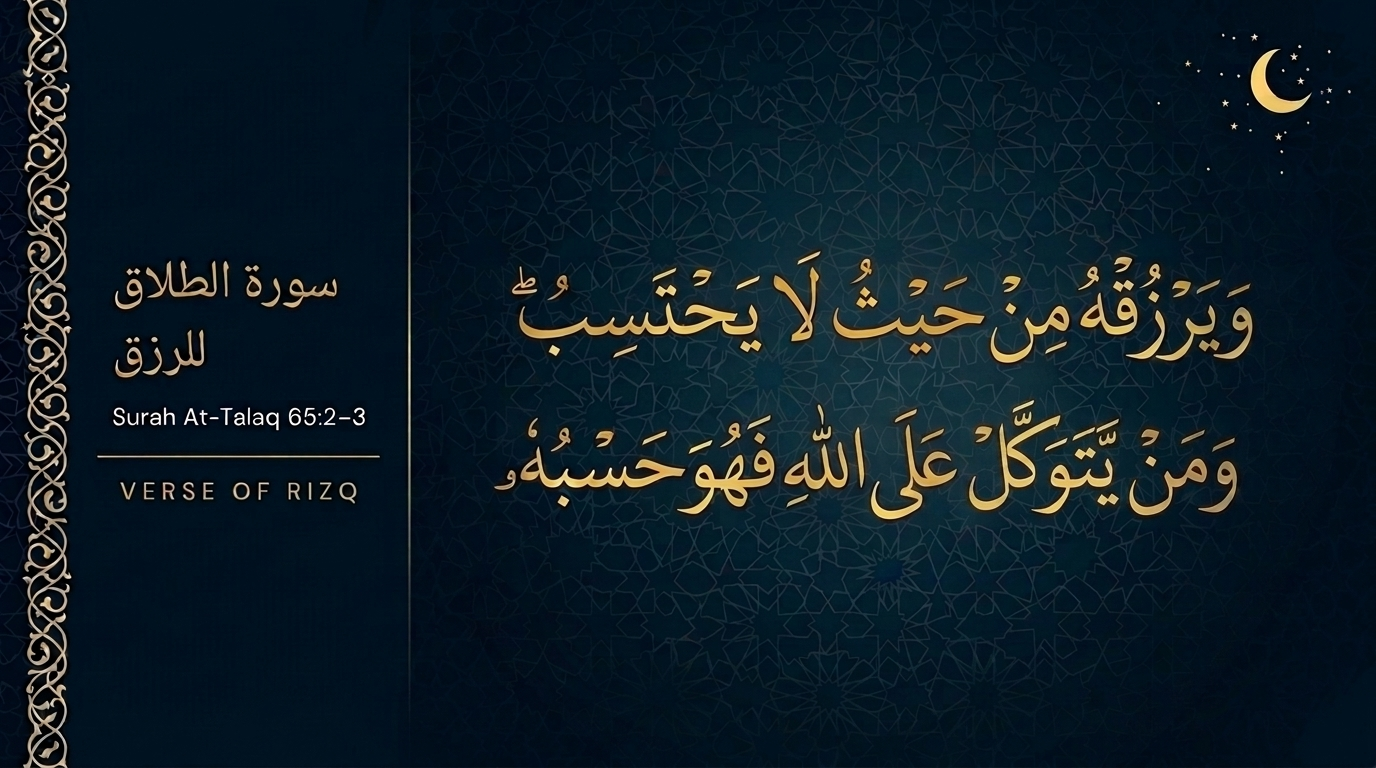
Surah At-Talaq Verses 65:2–3
Arabic
وَمَن يَتَّقِ اللَّهَ يَجْعَل لَّهُۥ مَخْرَجًا وَيَرْزُقْهُ مِنْ حَيْثُ لَا يَحْتَسِبُ ۚ وَمَن يَتَوَكَّلْ عَلَى اللَّهِ فَهُوَ حَسْبُهُۥ ۚ إِنَّ اللَّهَ بَالِغُ أَمْرِهِۦ ۚ قَدْ جَعَلَ اللَّهُ لِكُلِّ شَىْءٍ قَدْرًا
English Translation
“Whoever fears Allah, He will make for him a way out. And He will provide for him from where he does not expect. Whoever places his trust in Allah, then He alone is sufficient for him. Surely Allah accomplishes His command. Indeed, Allah has set a measure for everything.”
(Surah At-Talaq 65:2–3)
Why Are These Verses So Popular for Rizq?
Across Pakistan, India, Bangladesh, the Middle East, and Muslim communities worldwide, these verses are frequently shared as “Ayat for Rizq.”
The reason is simple.
Allah Himself promises three extraordinary blessings:
✔ A way out of hardship
✔ Provision from unexpected places
✔ Allah’s complete support for those who trust Him
These promises naturally inspire believers who are experiencing:
- Financial hardship
- Debt
- Business difficulties
- Job loss
- Family responsibilities
- Uncertainty about the future
However, understanding these verses requires reading them through the guidance of the Qur’an and authentic tafsir rather than treating them as a standalone prosperity formula.
Understanding the Context of Surah At-Talaq
One of the most common misunderstandings is reading these verses without considering the surrounding context.
Surah At-Talaq primarily discusses:
- Divorce ethics
- Family responsibilities
- Waiting periods (‘Iddah)
- Justice
- Obedience to Allah
Within this discussion, Allah reminds believers that those who obey Him—even during life’s most difficult situations—will never be abandoned.
This means the promise of rizq is connected to a lifestyle of obedience, sincerity, and patience rather than to the mere repetition of certain verses.
Tafsir of Verse 65:2
“Whoever Fears Allah…”
The verse begins with:
وَمَن يَتَّقِ اللَّهَ
This is the foundation.
What is Taqwa?
Taqwa means:
- Being conscious of Allah at all times
- Avoiding sins
- Performing obligatory acts of worship
- Choosing halal over haram
- Acting honestly even when nobody is watching
Many people ask:
“Which ayah should I read for more rizq?”
The Qur’an first asks another question:
“Are you living with Taqwa?”
This shows that spiritual reform comes before material blessings.
“…Allah Will Make a Way Out”
Allah says:
يَجْعَل لَّهُ مَخْرَجًا
The Arabic word Makhraj means:
- Exit
- Escape
- Solution
- Relief
- Opening
Notice that Allah does not specify only financial relief.
The “way out” may include:
- Recovery from illness
- Relief from debt
- Saving a marriage
- Finding employment
- Emotional peace
- Spiritual guidance
Sometimes Allah changes the situation.
Sometimes Allah changes the person.
Both are forms of His mercy.
Tafsir of Verse 65:3
“And He Will Provide from Where He Never Imagined”
Perhaps this is the most quoted part of the passage.
Allah says:
وَيَرْزُقْهُ مِنْ حَيْثُ لَا يَحْتَسِبُ
This teaches an important Islamic principle.
Allah’s provision is not limited by:
- Salary
- Business
- Economy
- Employers
- Markets
Allah can create opportunities beyond human planning.
Examples include:
- Unexpected employment
- Honest business opportunities
- Helpful people entering your life
- New skills leading to income
- Blessings that reduce unnecessary expenses
- Peace and contentment, which are also forms of rizq
Rizq is broader than money alone.
What Does “Rizq” Really Mean?
Many Muslims think rizq only means wealth.
The Qur’an presents a much broader understanding.
Rizq includes:
- Halal income
- Good health
- Righteous children
- Beneficial knowledge
- Time
- Peace of mind
- Strong faith
- Loving family
- Safety
- Barakah in what you already possess
A person earning modestly with contentment and blessings may, in reality, possess greater rizq than someone with immense wealth but constant anxiety.
“Whoever Trusts Allah”
Allah continues:
وَمَن يَتَوَكَّلْ عَلَى اللَّهِ فَهُوَ حَسْبُهُ
This introduces another essential condition.
Tawakkul
Tawakkul does not mean abandoning effort.
The Prophet ﷺ tied his camel before placing trust in Allah.
Therefore genuine Tawakkul combines:
- Prayer
- Honest work
- Planning
- Patience
- Reliance upon Allah
Islam never encourages laziness while expecting miraculous wealth.
“Allah Is Sufficient for Him”
This is among the strongest promises in the Qur’an.
When Allah says:
فَهُوَ حَسْبُهُ
He teaches believers that ultimate security comes from Him—not from employers, customers, governments, or financial markets.
This perspective transforms how Muslims approach life’s uncertainties.
Allah Has Fixed a Measure for Everything
The verses conclude with:
قَدْ جَعَلَ اللَّهُ لِكُلِّ شَيْءٍ قَدْرًا
Every blessing has its appointed time.
Every trial has wisdom.
Every provision has a measure.
Sometimes delayed rizq protects a believer.
Sometimes limited wealth protects faith.
Sometimes Allah grants more after patience.
The believer trusts Allah’s perfect timing.
9 Practical Lessons from These Verses
🌿 Life Lessons
- ✔ Taqwa attracts Allah’s help.
- ✔ Honest effort should always accompany dua.
- ✔ Allah can open doors beyond human imagination.
- ✔ Rizq includes health, family, knowledge, and peace.
- ✔ Never seek haram income believing it increases provision.
- ✔ Patience is part of trusting Allah.
- ✔ Financial hardship can become a means of spiritual growth.
- ✔ Allah’s timing is always perfect.
- ✔ Tawakkul brings inner peace even before circumstances change.
Common Misconceptions About Surah Talaq for Rizq
❌ Misconception 1: Reciting These Verses Automatically Makes You Rich
The Qur’an does not state that merely repeating these verses guarantees wealth. The promise is tied to taqwa, tawakkul, and living according to Allah’s guidance.
❌ Misconception 2: These Verses Replace Hard Work
Islam encourages believers to seek lawful livelihood. The Prophet ﷺ worked, traded, and taught that one should make effort while relying on Allah.
❌ Misconception 3: Rizq Means Only Money
The Qur’anic concept of rizq is much broader. Good health, righteous family, beneficial knowledge, contentment, and barakah are all forms of provision from Allah.
❌ Misconception 4: There Is a Guaranteed Number of Recitations
While many cultural practices recommend specific counts for recitation, there is no authentic evidence establishing a fixed number for these verses to obtain wealth. Muslims may recite the Qur’an regularly seeking Allah’s blessings, but should avoid attributing guaranteed outcomes to practices without authentic proof.
🌙 Reflect on Surah At-Talaq 65:2–3
Allah does not simply promise provision; He teaches the path to provision through Taqwa, Tawakkul, patience, and lawful effort. These verses invite believers to strengthen their relationship with Allah while striving for halal sustenance.
Learn Quran with Meaning →Practical Quran & Sunnah Guidance to Increase Halal Rizq
After understanding the beautiful promise of Allah in Surah At-Talaq (65:2–3), an important question arises:
How should a Muslim seek more rizq according to the Quran and Sunnah?
Islam teaches that rizq comes from Allah alone, but believers are instructed to combine faith, lawful effort, sincere dua, and reliance on Allah. The following practices are supported by the Quran and authentic Sunnah.
1. Strengthen Your Taqwa
The very first condition mentioned in Surah At-Talaq is taqwa.
Taqwa means living with awareness that Allah sees everything. It includes:
- Performing the five daily prayers consistently
- Avoiding haram income and dishonest dealings
- Speaking truthfully
- Respecting the rights of others
- Fulfilling family and financial responsibilities
The more a believer develops taqwa, the more they place themselves in a position to receive Allah’s guidance and blessings.
2. Make Halal Earnings Your Priority
The Prophet ﷺ emphasized the importance of lawful income.
Even if a haram source appears profitable, it removes barakah. A smaller halal income with Allah’s blessings is better than large earnings obtained through prohibited means.
Examples of halal earning include:
- Honest employment
- Ethical business
- Professional services
- Farming and trade
- Skilled craftsmanship
- Beneficial online work
3. Place Complete Trust (Tawakkul) in Allah
Tawakkul does not mean waiting without effort.
The Prophet ﷺ taught believers to tie their camel first, then trust Allah.
Today, tawakkul includes:
- Applying for jobs
- Learning new skills
- Running honest businesses
- Improving professional qualifications
- Seeking opportunities while making dua
A Muslim works hard but understands that success ultimately comes from Allah.
4. Seek Forgiveness (Istighfar)
The Quran repeatedly links istighfar with Allah’s mercy and blessings.
Regularly saying:
Astaghfirullah wa atubu ilayh
with sincerity softens the heart, strengthens faith, and reminds believers of their dependence upon Allah.
5. Maintain Family Ties (Silat-ur-Rahim)
Authentic hadith mention that maintaining family relationships is a means of receiving blessings in one’s provision and life.
Visiting relatives, helping parents, respecting elders, and resolving family disputes are all acts that strengthen society and earn Allah’s pleasure.
6. Give Charity (Sadaqah)
Many people fear charity will reduce wealth.
Islam teaches the opposite.
Giving sincerely for Allah’s sake brings barakah, supports those in need, and purifies one’s earnings.
Even small, consistent charity is beloved to Allah.
7. Make Dua with Sincerity
Allah loves those who ask Him.
When making dua for rizq:
- Begin with praise of Allah.
- Send blessings upon Prophet Muhammad ﷺ.
- Ask for halal, blessed, beneficial provision.
- Accept Allah’s timing with patience.
✅ Daily Rizq Checklist
Learn Quran with Authentic Understanding
Understanding verses about rizq becomes easier when learning directly from qualified teachers who explain the Quran with Tajweed, translation, and tafsir.
At Rizvi Quran Academy, students are encouraged to understand not only how to recite the Quran but also how to apply its teachings in daily life.
Meet Your Quran Tutor
📋 Rizq Reflection Assessment
How many of these do you practice consistently?
Five Daily PrayersHalal Income
Daily Quran Reading
Daily Istighfar
Charity
Tawakkul After Effort
Frequently Asked Questions
No. The verses promise Allah's help and provision for those who have taqwa and tawakkul. They should not be understood as a guaranteed formula for becoming wealthy.
Yes. Regular Quran recitation is encouraged. Reflect on the meaning and strive to implement its teachings.
No. Rizq includes health, knowledge, righteous family, peace, time, opportunities, and halal income.
No. Islam teaches believers to work honestly while placing their trust in Allah.

Begin Learning the Quran with Understanding
Join one-on-one online Quran classes with Hafiz Muddasir Rizvi. Learn Quran Reading, Tajweed, Memorization (Hifz), Tafsir, and Islamic Studies through personalized lessons designed for children and adults.
📞 Phone: +92 311 6341619
📧 Email: info@rizviquranacademy.pk
📍 Address: Shah Rukn-e-Alam, Multan, Pakistan